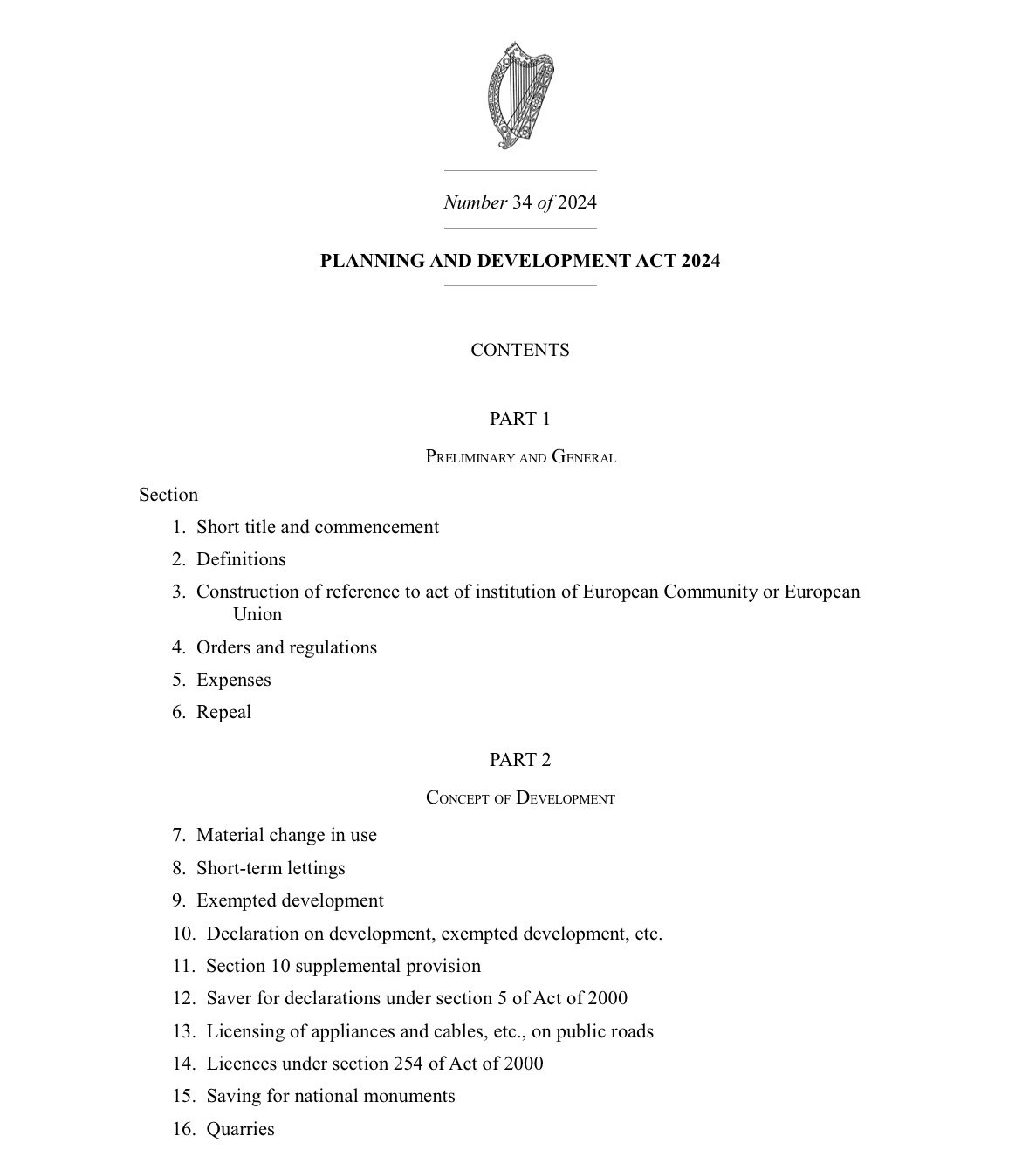
An important part of buying a home in Galway or Mayo is ensuring that it is planning compliant. As part of our standard property survey package, we do a planning search on your property and check the planning status.
A planning search is important to establish when the original property was built or if it was built before planning laws were in place, i.e. before the 1/10/1964 when the Local Government (Planning & Development) Act 1963 was enacted.
All property after this date is required to have the benefit of planning permission. All work to a property is also required to have planning permission, except works like extensions and sheds, that are usually planning exempt, if they meet the exemption criteria set out in the Planning & Development Regulations.
Often times a client will say that “we don’t need a planning search, our Solicitor has already gotten one done”. However, the search that a Solicitor gets is a legal search of the planning records only - there is no evaluation of the files to see if they match what is built.
This is where we come in! We review these planning files (if available) and check them during our property survey. We compare what is approved to what is built and we look for “substantial compliance”. We also comment on any extensions or alterations to see if they meet the criteria of being planning exempt.
What is “Substantial Compliance”?
It is unreasonable to look for a level of conformity that is down to the millimetre. Substantial Compliance is something that is built that generally reflects what was approved at planning stage, but there may be subsequent changes or alterations that are considered as trivial. Such trivial matters are generally overlooked, provided they do not affect the planning and development of an area as envisaged by the Planning Authority.
Works or changes that are beyond “Substantial Compliance” are usually listed in our report. It is likely that they may require Retention Permission, to regularise their planning status.
Planning problems usually arise in the following common situations:
If the site that planning originally relates to has been altered.
If the changes or alterations are beyond Substantial Compliance.
Noncompliance with planning conditions.
Unauthorised works/extensions.
Attic conversions for habitable use.
Misinterpretation of exemption rules.
Surely, after 7 years, everything is OK?
Not necessarily. There is a part of the Planning & Development Act 2000-2026 that states that the Planning Authority are statute barred from taking enforcement proceedings after a period of 7 years has passed (5 years in older legislation), without complaint.
However, this does not regularise the planning history. The works are still noncompliant, but they exist in a limbo state. This can make it hard to sell a property, as it still does not have the benefit of planning permission.
Are you going to wait for a cash buyer? If someone has accrued enough cash to purchase a property (with planning trouble), why is it considered that they would be so foolish to spend it on something that is not legally sound?
There are also misconceptions around the 7-Year Rule that are frequently misinterpreted. The 7 years commence after the validity of a planning permission has expired. This can be 5 years (or 8 years in the case of outline/permission consequent). So, 7 + 5 is 12 years (or 7 + 8 is 15 years!).
Let’s complicate it a bit more. The 5 years is also increased by 9 or 10 bank holiday days for each year and then 2 months or so if the application was valid during Covid years. So, the 5 years is even longer!
To complicate it even further, the conditions of a permission concerning the use of land are always enforceable. Therefore, if there is a planning condition regulating use (like, “development to be carried out in accordance with the documents lodged”), then the 7 year rule may never be applicable in the first instance!
So, be careful with 7-year rule claims, as they may not always be as straightforward as you think.
Retention solves everything?
Not necessarily. Unauthorised works that contravene development plan standards may never be granted retention, because they may fundamentally contravene the criteria for permission in the first place.
The test that we apply at My Engineer Ltd is that if it would not have been granted as a standard planning application in the first instance, then it is unlikely to be granted retention subsequently.
Also, if retention is sought and granted, some Planning Authorities may require a development contribution (charged at today’s rates).
In summary:
A planning search is an important part of any pre-purchase survey report. It examines a very serious matter regarding compliance which can have serious consequences if overlooked.
We have had cases where a Vendor is selling on a property and it is later found that there is a planning issue. The reason it never came to light before is because there was no planning search undertaken by their surveyor in the first instance! Whilst vendors and their agents may try to trivialise compliance matters, retention is a costly business after the fact.
So, don’t overlook the importance of a Planning Search when buying a home in Galway or Mayo.